Dyeing Journal – Log Nº2
Rubia Tinctorum

Welcome back to the Dye Journal !!

After the blues of Log Nº 1, I wanted to go to the other side of the colour wheel. Reds. Deep, rich, proper reds. So this time it’s madder. Well at least that’s what was promised in the recipes and videos jaja.

Rubia Tinctorum

Madder, Rubia tinctorum, is one of the oldest dye plants there is. People have been dyeing with it for thousands of years, all the way from the Indus Valley to the famous Turkey red cottons. The colour isn’t in the flowers or the leaves, it’s in the roots. Inside them are two main colour compounds, alizarin and purpurin, which give reds, oranges and everything in between, depending on how you treat them.

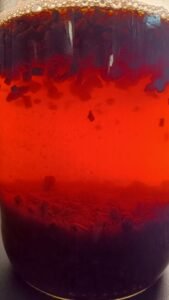
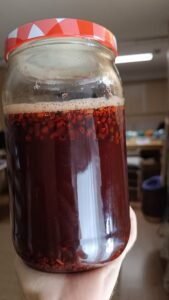
The madder root soaked in a jar with 1.5 litres of water for at least 24 hours. By the next day the water was a deep red-brown, and with the light behind it the jar glowed ruby red. I used 50 grams of root for 90 grams of yarn.

I got my madder root from Tejo lo que Hilo, Mar’s craft shop and studio in Sant Celoni, Barcelona. If that name sounds familiar, it’s because the plant-dyed Encina yarn in the Cotorra vest from Refugio is theirs too.

The mordant

This is where madder is completely different from indigo. A mordant is what helps the dye grab on to the fibre and stay there. The word comes from the Latin mordere, to bite. yes …. very sexy and romantic. Without one, most plant colours just wash out or fade after a single wash.

A few plant dyes don’t need a mordant. Indigo works in its own way, as you saw in Log Nº 1. Others, like walnut hulls or some lichens, bond to the fibre all by themselves. These are called substantive dyes. But the vaaaast majority of dye plants need a mordant, and madder is one of them.

The classic mordant is alum, a mineral salt dyers have been using for centuries. There are other options too: tannins from oak galls, pomegranate rind or sumac; symplocos, a plant that naturally stores aluminium in its leaves; and iron, which darkens and “saddens” colours. And here’s the fun part: the same dye can give completely different colours depending on the mordant you use.

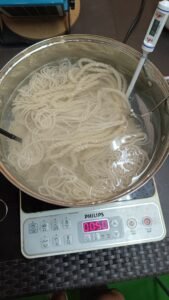
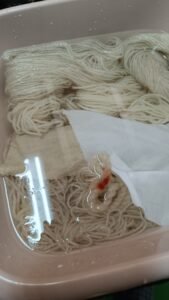
I used a simple alum mordant: 15% alum on the weight of the yarn, no cream of tartar. The yarn went into the mordant bath for 1 hour at 80 °C, and then I left it in the pot until it had completely cooled down. You know that the yarns has being successfully mordanted because i accidently spilled a drop of madder dye and welp , it instantly absorbed the colour haha.

Dye Bath

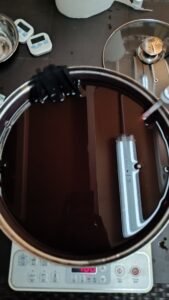
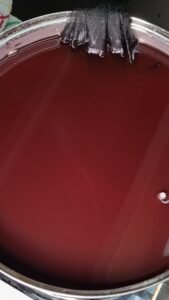
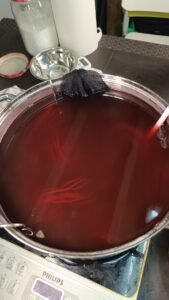
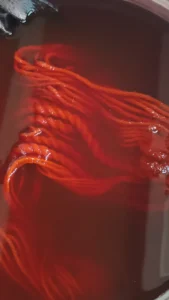
Everything went into a big pot, around 10 litres of water, and I kept it at a maximum of 60 °C. I never went above that. The roots stayed in a mesh bag hanging over the edge of the pot, so they wouldn’t get tangled in the yarn.

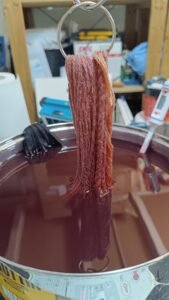
Each yarn was split into three, so I could get three different shades from the same bath. The first set went in. After an hour, I added the second set. An hour later, the third. None of them came out until the end, so the first set spent the longest in the bath and got first pick of the colour, and every new set went into a bath with less dye left in it.

This is the part I loved watching. With every batch, the yarn takes some of the colour with it, and you can see the water change. It starts saturated and opaque, a deep oxblood, and by the end it’s almost translucent. The soft salmons and baby peach came from that leftover bath.

The yarns:
Dehesalana, chunky merino, 15 g. Dehesalana is a project of ACTYVA, a social economy cooperative in Cáceres, bringing Extremaduran merino back to homes and workshops.
Dehesalana, 100% merino, 4-ply, 30 g.
El Robledal de la Santa, mohair, 2-ply, handspun by me, 15 g. From David and Jackson’s angora goats in Santa María de las Lomas, the same mohair that runs through Signum, Viride, Sol and Herba.
Wooldreamers, Origen, 70% superfine merino and 30% alpaca, 30 g.
Results

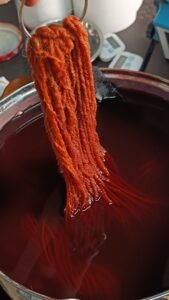
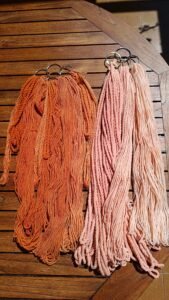
The first batches came out a deep rust, burnt orange. Really warm, really intense. The second and third batches each came out lighter in colour. Then the exhaust bath gave these lovely pinky salmons and baby peach. I didn’t expect how much I would love those baby peach and salmon.

The yarn that took the most colour was the Dehesalana chunky merino. The one that took the least was my handspun mohair, which stayed a brighter, lighter orange next to the others. It goes to show that not every wool is the same: the very structure of mohair is different from that of merino.

But no reds. My initial goal was deep reds and I didn’t get there. And I’ve seen dark, deep blood reds made with madder, in person and in videos and photos. What I got instead is a whole palette of oranges, rusts and peaches that I honestly love.

What I’d do differently
– After the dye day I watched some videos that said you need cream of tartar in the mordant, and a higher temperature, closer to 70 °C. I stayed at 55–60 °C. Next time I’ll try that.
– The water needs to be a bit harder, with a higher pH, maybe around pH 8. Adding a bit of CaCO3 should do it.
– Leave the madder root an extra day in the jar.
– Use madder at 100% of the yarn weight instead of 50%.


Shopping Basket
Scroll to Top