Dyeing Journal – Log Nº1
Indigo

Welcome to the Dye Journal !!

The Spinning Journal has a sister now, one of three, the last one being the bioyarns. In the very first post on this blog I said I would talk about dyeing, about colour, about all the side projects that happen in the background of Umbruma. The Dye Journal is going to be a series of logs, like notes from the dye pot. What plant, what fibre, what happened in the vat, what came out the other side. Come along because there’s a rainbow of colours to discover, like a lot.

And I couldn’t start with anything other than Indigo. Not the easiest to start with to be honest. I learned that afterwards.

indigo

My very first natural dye test was with Indigoremus, a natural indigo pigment by Tintoremus. And not just any batch: I bought their very first harvest, from the summer of 2023.

Tintoremus grow their indigo in Santa María de las Lomas, in Cáceres, Extremadura, on farmland that used to grow peppers and tobacco and had been left abandoned. Today they call it the largest indigo cultivation in Europe. The plant is Persicaria tinctoria, Japanese indigo, the same plant used in Japan for aizome. The leaves are cut and fermented in water, and the pigment is extracted from that liquid and dried into a deep blue powder. Since then, they already offer other pigments for dyeing, go check out their website it is so interesting.

Here is the part I love: Santa María de las Lomas is the same small village where David and Jackson raise their angora goats at El Robledal de la Santa, the mohair that runs through Signum, Viride, Sol and Herba. Same corner of Extremadura. Tis a small world indeed.

Mother Vat

Indigo is strange, and that is what makes it magic. The powder is blue, but it doesn’t dissolve in water. To dye with it, you first have to take the oxygen out, a chemical reduction that turns the indigo soluble. And when it is soluble, it isn’t blue at all.

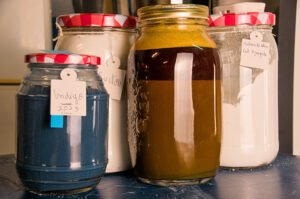
I used the 1-2-3 method, following the instructions that came with the indigo: 1 part indigo, 2 parts calcium hydroxide (slaked lime), 3 parts fructose. The lime makes the water alkaline, and the fructose does the reducing, pulling the oxygen out.

For 425 grams of fibre, my mother vat 1.2.3 formula was:
– 25 g indigo
– 50 g calcium hydroxide
– 75 g fructose
1 litre of water at 50 °C, in a 1.5 litre glass jar with an airtight lid Close the jar and shake it for 30 seconds every 5 minutes, five times. Then let it rest for at least two hours.

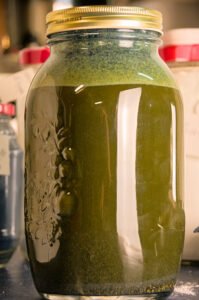
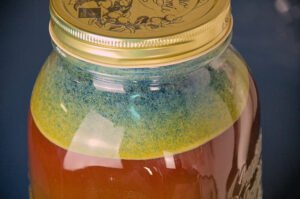
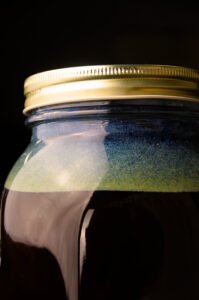
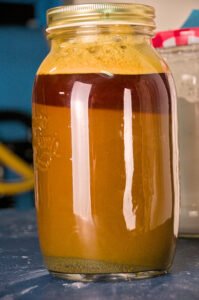
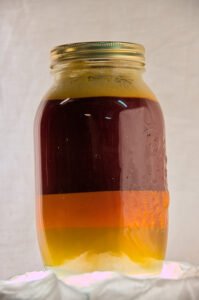
Right after shaking, the jar was a murky olive green with a speckled green foam on top. Where the foam touched the air at the neck of the jar, it was already turning blue. This means there was still oxygen in the mix. Over the next two to three hours you can watch it separate, first into 2 layers then 3, then 4 and finally into five layers: a yellowy foam of bubbles on top, a big band of dark coffee-red liquid, a layer of bright orange, a light green, and a thin line of sediment at the bottom. That is how you know the reduction has worked. Mother vat is ready.

Dyeing process

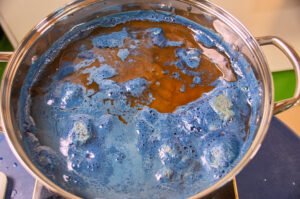
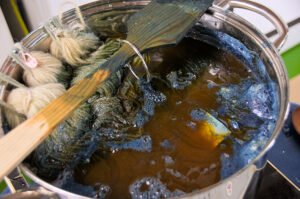
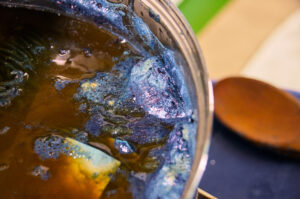
The mother vat goes into the dye vat: a 10 litre pot with 5 litres of water at 50 °C, poured in slowly and mixed gently so as not to put oxygen back in. Twenty minutes of rest, and a pH around 10–10.5, which is the right range for wool and other animal fibres. The liquid itself was golden green. The only blue was on the surface: the indigo flower, a bloom of cobalt blue, bubbly foam that floats on top of the vat and creeps around the edges of the pot. It’s the indigo meeting the air at the surface, and it’s one of the signs that the vat is alive and ready. Dyeing time !!!

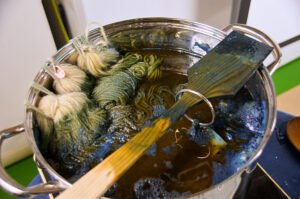
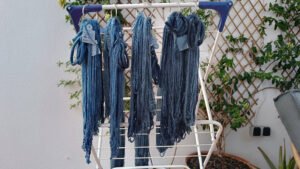
This is the moment everyone films, me included and for good reason. The yarn goes into the vat its natural colour and comes out yellow-green with a bit of blue. Then, in the air, in front of you, it turns blue. Not over hours, over seconds and minutes. The colour fixes as the indigo meets oxygen again and becomes insoluble, this time inside the fibre. Full oxidation takes around 45 minutes. I filmed a lot of moment of the process and steps and it is work but so much fun.

9 yarns, 5 times, 45 samples and 3 ombré skeins

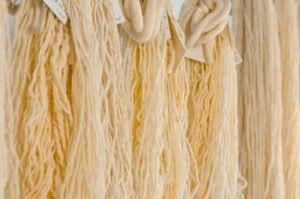
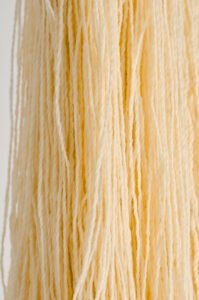
I didn’t want to just dye one skein. I wanted to understand what was happening. So I made a grid. Nine different yarns, all in their natural undyed colour, each one split into five small 5 gram samples. Each sample went into the vat for a different time:
– 1 dip, 5 minutes
– 1 dip, 10 minutes
– 1 dip, 15 minutes
– 1 dip, 20 minutes
– 1 dip, 20 minutes, then around 40 minutes of oxidation, then a second dip of 5 minutes.

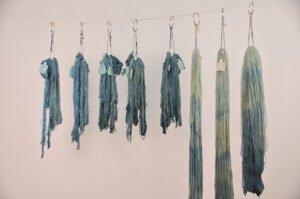
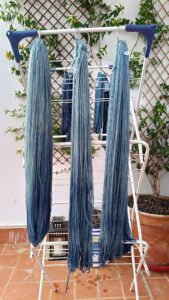
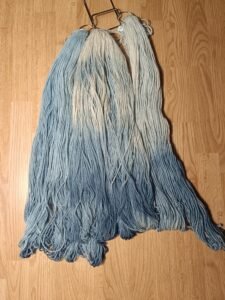
The grid was the experiment. Then I wanted to see the same idea in a full skein. I took three whole skeins and wanted to try an ombre effect. To make the ombré, I only put the bottom of the skein into the pot and let the rest hang over the edge. Every five minutes I lowered it a little further in, until the bottom had been in for 20 minutes. The bottom got 20 minutes, the next section 15, then 10, then 5 at the top. The result is a skein that steps from pale sea-glass at the top to deep denim at the bottom. It is the 5, 10, 15, 20 minute grid all in one continuous yarn.

I’m sure you’re going to recognise some of the yarns that i used:

Alpacas El Camino, Boreas, 100% suri alpaca. Spun by me into a 2-ply. Yes, the Spinning Journal and the Dye Journal meet in the very first log.

Alpacas El Camino, Marino, 50% alpaca, 25% merino, 25% nettle. The same yarn as in Terra, with merino from Fuente de los Romeros, Miro and Rita’s flock.

Alpacas El Camino, suri alpaca and Egyptian cotton. The alpaca comes from Tristán, one of their own animals.

Dehesalana, 100% white merino, 4-ply. Dehesalana is a project of ACTYVA, a social economy cooperative in Cáceres, born in 2015 to bring Extremaduran merino back to homes and workshops, and to fight the idea that wool is a byproduct. It isn’t.

Dehesalana, 100% white merino, 2-ply, handspun by me from their combed wool. Same fibre as the one above, one spun by a mill, one spun by me, side by side in the same vat.

dLana, Romera, 100% merino (ombré). From Fuente de los Romeros, Miro and Rita’s flock. Miro spent many days of his childhood in the shepherds’ huts of northern León and gave his life to transhumance, and in 2019 his project Retornar al Origen created the first flock in Spain combining Spanish and Australian merino genetics. dLana, Esther and Javi’s project, have worked with their wool since 2022. The natural white of this yarn is the colour of the flock itself.

Wooldreamers, alpaca and merino (grid and ombré). The natural yarn of Signum, Sol and Herba: alpaca from Alpacas del Miera in Cantabria and merino from Dehesa de Barrera in Extremadura.

Wooldreamers, Mota Alpaca, 2-ply (ombré). Half alpaca from Alpacas del Miera, half Manchega and extrafine merino.

Wooldreamers, one-off merino and cotton. From the same limited production run as the yarn in Floris.

Wooldreamers, Ripollesa. From their Breeds collection, one skein per native Spanish breed. The Ripollesa is a Catalan sheep, born from an ancient cross between the sheep of the central Pyrenees and merino brought in by transhumance, and named after the Ripollès. It is classified as an endangered native breed. This one is a felt yarn, thick and soft.

Wooldreamers, Saona, Spanish wool and Andalusian cotton. The yarn of the Sierra dress.
Results

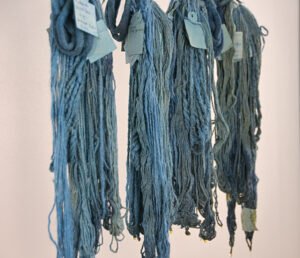
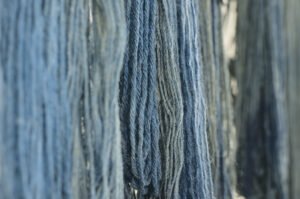
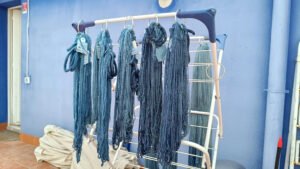
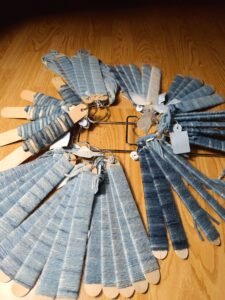
Time does what the instructions promise: the longer in the vat, the deeper the blue. The 5 minute samples came out a soft, pale aqua, and the lightest ones have a little sea-glass green in them. Each category steps down from there, through clear sky blues and denim, and the samples with the second dip went the furthest, almost to ink. Its hard to describe exactly the colour through a camera and computer screen but its blueeeee alright. Though i also realise that a lot of the sample came striped, marbled in a way , you can definitely see the shift in darkness and lightness of colours and what yarns took up more dye than others. Example , the yarns that had cotton in them are less saturated than the pure wool ones.

The felt-style Ripollesa drank the blue and went a deep slate, it’s a thirsty yarn for sure. And the colour isn’t perfectly flat. Some samples have darker flecks and little pale spots where the dye took more or less. That is a hand vat, and I love it. The cotton yarns definitely came out less saturated. What surprised me the most and i think came out the best was the hand spun suri alpaca, from baby blue to jean blue . adore. Also, depending on the light , the blue will shift.
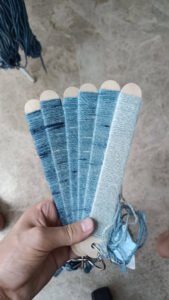

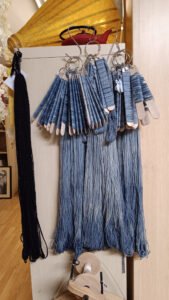
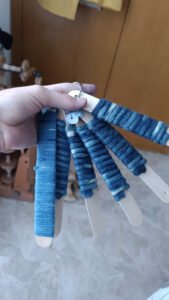
After rinsing a couple of times in cold water, with a splash of white vinegar in the last rinse to bring the pH back down, every sample was wound onto a little wooden stick. One set per yarn, light to dark, like a colour chart. It is now a small blue archive hanging in the atelier. You can see from the pictures that a lot of samples and variations came out .

I learned a couple of things that i would do differently next time i try Indigo :
– having more room in the pot so a bigger pot
– putting a metal base so the yarn doesn’t touch the sediment at the bottom cuz it was a little pain in the ass to remove it during rinsing and it can cause those areas in contact to be more saturated.
– diluting the dye vat a bit more or putting less mother vat cuz i feel like i didn’t get those super light baby pastel blues.
– and on the oposite scale , do more concentrated vat or do more dipping to get the intense dark blues.
– not trusting the process…. trust it , it will be alright .

Shopping Basket
Scroll to Top